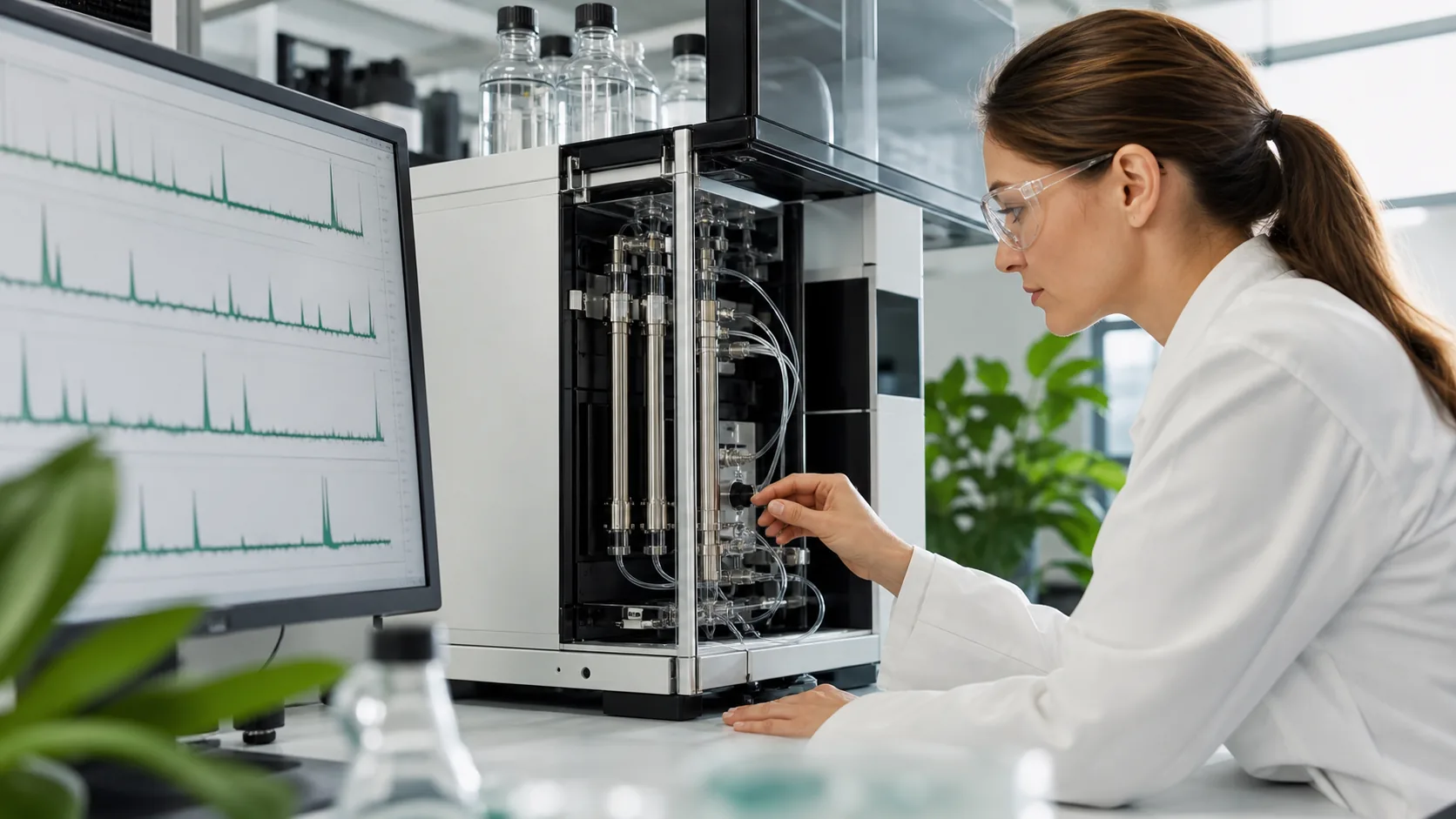
High-performance liquid chromatography (HPLC) remains the gold standard for verifying peptide purity. For researchers sourcing compounds from third-party suppliers, the ability to read and interpret an HPLC report is essential. It separates credible, research-grade material from everything else.
This guide covers the fundamentals of HPLC purity analysis, what to look for on a chromatogram, and how to evaluate whether a compound meets the standards your research demands.
What Is HPLC and Why Does It Matter?
HPLC is an analytical separation technique that pushes a liquid sample through a column packed with solid adsorbent material under high pressure. Different molecules in the sample interact with the column material at different rates, causing them to separate as they travel through the column.
For peptide research, HPLC serves one primary purpose: quantifying how much of the sample is the target compound versus impurities. A single dominant peak on the chromatogram indicates a high-purity sample. Multiple peaks suggest the presence of truncated sequences, deletion peptides, or other synthesis byproducts.
How to Read an HPLC Chromatogram
A chromatogram is the visual output of an HPLC analysis. It plots detector response (typically UV absorbance at 214nm or 220nm) on the Y-axis against time on the X-axis. Each peak represents a component in the sample.
Key Elements to Evaluate
- Main Peak (Target Peptide): The tallest, most prominent peak represents the target compound. Its retention time should match the expected value for the peptide being analyzed.
- Peak Area Percentage: Purity is calculated by dividing the area under the main peak by the total area of all detected peaks. A result of 98.5% means 98.5% of the detected material is the target peptide.
- Secondary Peaks: Smaller peaks flanking the main peak indicate impurities. These could be deletion sequences (missing one or more amino acids), oxidized forms, or residual protecting groups from synthesis.
- Baseline Stability: A flat, stable baseline indicates a clean separation. A noisy or drifting baseline may suggest column degradation or mobile phase issues, which can affect accuracy.
- Retention Time: The time at which the main peak elutes from the column. This value is characteristic of each peptide under specific conditions and serves as a secondary identity confirmation.
Purity Grades: What the Numbers Mean
Not all research applications require the same level of purity. Understanding the standard purity tiers helps you select the right grade for your work.
| Purity Grade | Percentage | Typical Application |
|---|---|---|
| Crude | <70% | Initial screening, antibody production |
| Desalted | 70-85% | ELISA standards, preliminary assays |
| Standard | ≥95% | Most in vitro research, cell-based assays |
| High Purity | ≥98% | Quantitative studies, SAR research, reproducibility-critical work |
| Ultra-Pure | ≥99% | NMR studies, X-ray crystallography, reference standards |
At Peptera Research, our standard catalog compounds are supplied at ≥98% purity, verified by independent HPLC analysis. This ensures consistency and reproducibility across experiments.
Reversed-Phase HPLC: The Industry Standard
The most common HPLC mode for peptide analysis is reversed-phase HPLC (RP-HPLC). In this configuration, the stationary phase is hydrophobic (typically C18-bonded silica), and the mobile phase is a gradient of water and acetonitrile, both containing a small percentage of trifluoroacetic acid (TFA) as an ion-pairing agent.
RP-HPLC separates peptides based on their hydrophobicity. More hydrophobic peptides interact more strongly with the column and elute later. This method is highly reproducible and works well for peptides ranging from 5 to 50 amino acids in length.
Standard Analytical Conditions
- Column: C18, 4.6 x 150mm or 250mm, 5μm particle size
- Mobile Phase A: 0.1% TFA in water
- Mobile Phase B: 0.1% TFA in acetonitrile
- Gradient: 5-65% B over 30 minutes (typical)
- Flow Rate: 1.0 mL/min
- Detection: UV at 214nm or 220nm
Common Impurities in Synthetic Peptides
Understanding what those secondary peaks represent helps you assess whether a sample is suitable for your specific application.
- Deletion peptides: Sequences missing one or more amino acids from the target. These are the most common synthesis impurity and appear as peaks eluting near the target.
- Truncated sequences: Incomplete chains resulting from premature termination during solid-phase synthesis.
- Oxidized forms: Methionine and tryptophan residues are susceptible to oxidation, creating peaks with slightly different retention times.
- Deamidation products: Asparagine and glutamine residues can undergo deamidation over time, particularly in solution.
- TFA/acetate salts: Residual counterions from purification. While not detected by UV at 214nm, they contribute to the total mass of the sample.
What to Verify on a Certificate of Analysis
When you receive a Certificate of Analysis (CoA), confirm the following HPLC-related data points:
- Purity percentage matches or exceeds the stated specification
- Method details are documented (column type, gradient conditions, detection wavelength)
- Chromatogram is included or available upon request
- Batch/lot number on the CoA matches the product label
- Date of analysis is recent relative to the manufacturing date
A supplier that cannot provide HPLC data for a specific batch is a supplier you should question. At Peptera Research, every lot ships with full analytical documentation.
Frequently Asked Questions
What is HPLC purity analysis?
High-performance liquid chromatography (HPLC) is an analytical technique used to separate, identify, and quantify components in a peptide sample. It is the gold standard method for determining peptide purity in research-grade compounds.
What purity percentage should I look for in research peptides?
For most research applications, a purity of ≥95% is considered acceptable. For sensitive studies requiring high reproducibility, peptides with ≥98% purity are recommended. Peptera Research supplies compounds at ≥98% purity as standard.
How do you read an HPLC chromatogram?
A chromatogram displays peaks representing different components in the sample. The tallest peak represents the target peptide. Purity is calculated by dividing the area of the target peak by the total area of all peaks and multiplying by 100. A single dominant peak with minimal secondary peaks indicates high purity.
Summary
HPLC purity analysis is the cornerstone of peptide quality verification. By understanding how to read a chromatogram, interpret purity percentages, and identify common impurities, researchers can make informed decisions about the compounds they use. Reliable suppliers provide this data transparently, for every batch, without exception.
Browse our Research Catalog to explore compounds backed by full HPLC documentation and independent third-party testing.