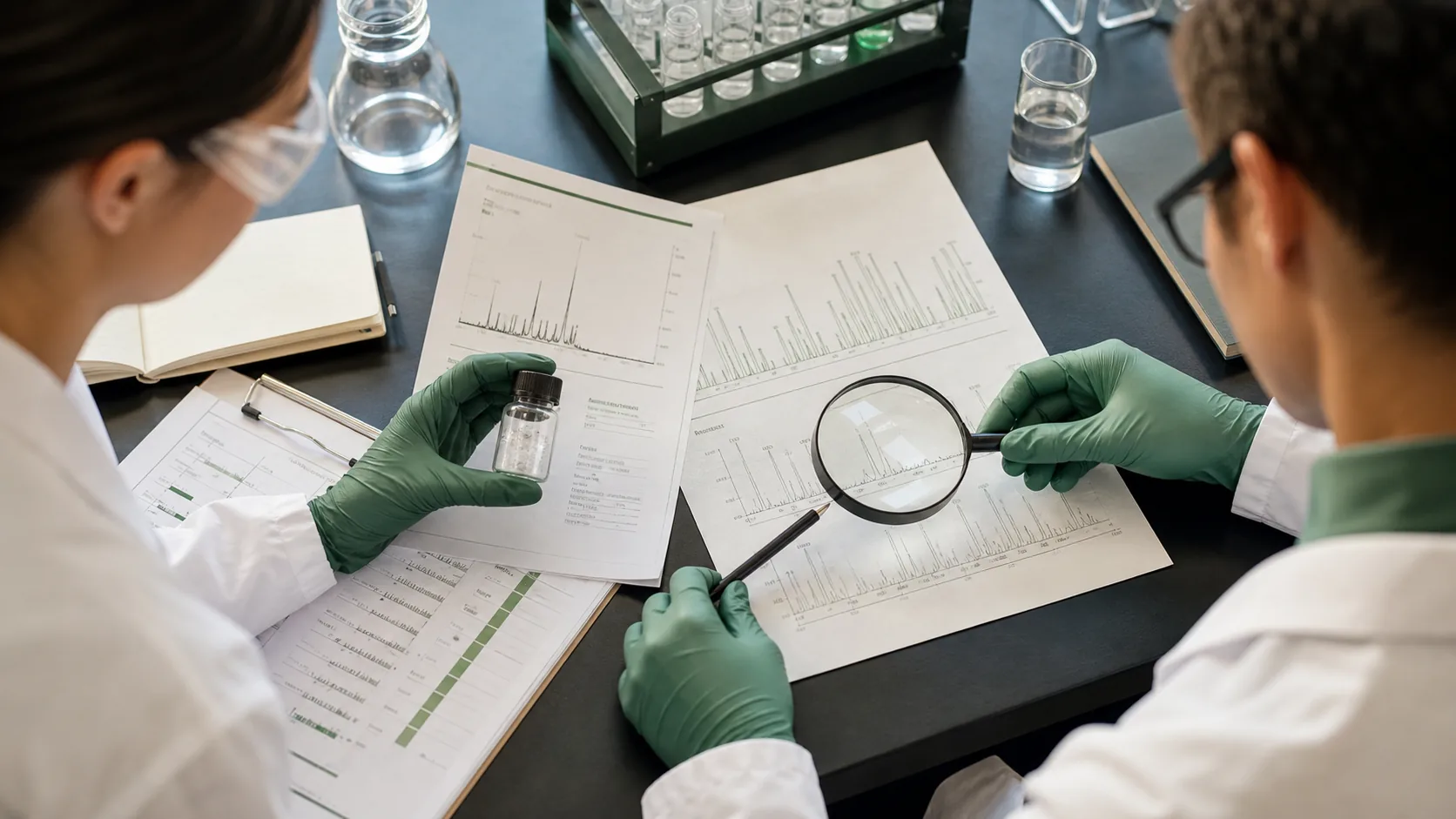
A Certificate of Analysis is more than a formality. It is the single most important document a researcher can use to verify that a compound meets the specifications required for their work. Understanding what to look for in a CoA, and what should raise concern, ensures that your research compounds meet the standards your work demands.
This guide breaks down each component of a peptide CoA, explains what the data means, and identifies the warning signs that indicate a supplier may not be delivering what they claim.
What Is a Certificate of Analysis?
A Certificate of Analysis (CoA) is a document issued by the manufacturer or an independent testing laboratory that certifies the identity, purity, and quality of a specific batch of product. For research peptides, the CoA serves as proof that the compound has been analytically tested and meets defined specifications.
Every legitimate peptide supplier should provide a CoA for every batch. If a supplier cannot produce one, or provides only generic documentation, that is a significant concern.
Essential Components of a Peptide CoA
A complete, trustworthy CoA for a research peptide should include the following data points:
| Component | What It Tells You | What to Verify |
|---|---|---|
| Peptide Name / Sequence | Identity of the compound | Sequence matches your order exactly |
| Batch / Lot Number | Traceability to a specific production run | Matches the label on your vial |
| HPLC Purity | Percentage of target compound vs. impurities | Meets or exceeds stated specification (e.g., ≥98%) |
| Mass Spectrometry (MS) | Confirms molecular weight matches the expected value | Observed MW within ±1 Da of calculated MW |
| Appearance | Physical description of the product | Should match what you received (e.g., "white lyophilized powder") |
| Net Peptide Content | Actual peptide mass vs. total mass (includes salts/moisture) | Important for accurate concentration calculations |
| Storage Conditions | Recommended storage to maintain stability | Consistent with the compound's known stability profile |
| Date of Manufacture | When the batch was produced | Should be recent relative to your purchase date |
| Date of Analysis | When testing was performed | Should follow the manufacture date, not predate it |
HPLC Data: The Purity Foundation
The HPLC purity analysis is the most critical section of any peptide CoA. It provides a quantitative measure of how much of the sample is the target compound versus impurities.
A credible CoA should include either the chromatogram itself or a clear summary showing:
- The purity percentage (e.g., 98.7%)
- The analytical method used (e.g., RP-HPLC, C18 column)
- Detection wavelength (typically 214nm or 220nm)
- Retention time of the main peak
For a deeper look at interpreting HPLC data, see our full guide: Understanding HPLC Purity Analysis in Peptide Research.
Mass Spectrometry: Identity Confirmation
While HPLC tells you how pure the sample is, mass spectrometry (MS) tells you what the sample actually is. It measures the molecular weight of the compound and compares it to the calculated value based on the amino acid sequence.
The two most common MS methods for peptides are:
- ESI-MS (Electrospray Ionization): The standard method for peptides. Produces multiply charged ions that allow accurate mass determination for peptides up to ~25 kDa.
- MALDI-TOF (Matrix-Assisted Laser Desorption/Ionization): Produces singly charged ions and is often used for larger peptides and quick identity checks.
On the CoA, look for the observed molecular weight and compare it to the calculated molecular weight. They should agree within ±1 Dalton. A larger discrepancy may indicate a sequence error, a modification, or contamination.
Net Peptide Content: Why It Matters
A vial labeled "5mg" does not necessarily contain 5mg of pure peptide. The total mass includes the peptide itself plus counterions (typically TFA or acetate salts) and residual moisture from lyophilization.
The net peptide content (usually expressed as a percentage) tells you what fraction of the total mass is actual peptide. Typical values range from 60% to 85%. This number is essential for calculating accurate molar concentrations when reconstituting.
For example, if a 5mg vial has a net peptide content of 75%, the actual peptide mass is 3.75mg. Your concentration calculations should use this adjusted value.
Red Flags vs. Green Flags
Warning Signs on a CoA
- No batch or lot number
- HPLC purity stated without a chromatogram or method details
- No mass spectrometry data
- Generic, templated results that look identical across different compounds
- Analysis date that precedes the manufacturing date
- Missing net peptide content
- Supplier refuses to provide a CoA for a specific lot
Signs of a Credible CoA
- Unique batch/lot number that matches the product label
- HPLC chromatogram included with method details
- Mass spectrometry data with observed vs. calculated MW
- Net peptide content clearly stated
- Third-party or independent laboratory testing
- Specific storage recommendations for the compound
- Coherent date sequence: manufacture → analysis → release
Frequently Asked Questions
What is a Certificate of Analysis (CoA)?
A Certificate of Analysis is a document issued by a manufacturer or testing laboratory that certifies the quality, purity, and identity of a specific batch of product. For research peptides, a CoA typically includes HPLC purity data, mass spectrometry confirmation, physical appearance, and storage recommendations.
What should a peptide CoA include?
A complete peptide CoA should include: the peptide name and sequence, batch/lot number, HPLC purity percentage with chromatogram, mass spectrometry data confirming molecular weight, physical appearance description, net peptide content, storage conditions, date of manufacture, and date of analysis.
What are red flags on a Certificate of Analysis?
Red flags include: no batch or lot number, missing HPLC chromatogram, no mass spectrometry data, generic or templated results not specific to the batch, analysis dates that predate the manufacturing date, and purity claims without supporting analytical data.
Summary
A Certificate of Analysis is your proof of quality. It confirms compound identity through mass spectrometry, quantifies purity through HPLC, and documents the conditions under which your compound was tested. Treat it as required reading for every batch you receive.
At Peptera Research, every compound ships with a complete Certificate of Analysis including HPLC chromatogram, mass spectrometry data, and net peptide content. No exceptions.
Browse our Research Catalog to explore compounds backed by full analytical documentation, or contact our team to request a CoA for a specific lot.