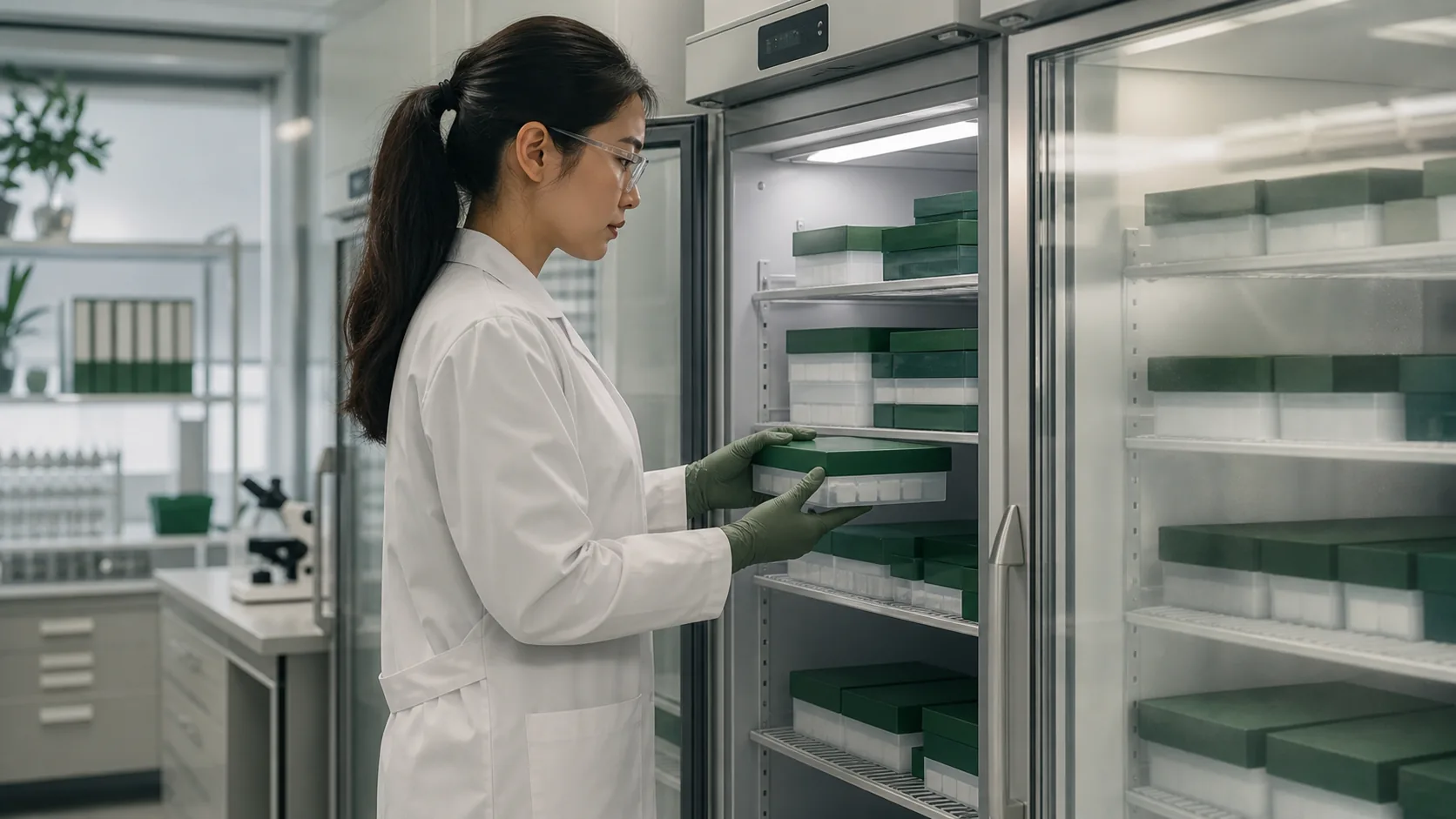
Proper storage is critical to maintaining peptide integrity. A compound that tests at 99% purity on the day of manufacture can degrade significantly within weeks if handled or stored incorrectly. Temperature, light exposure, moisture, and reconstitution protocols all play a role in preserving compound stability over time.
This guide outlines the essential storage and handling practices that protect your research investment and ensure consistent, reproducible results.
Lyophilized vs. Reconstituted: Two Different Storage Profiles
Peptides arrive in one of two forms, and each has distinct storage requirements.
| Property | Lyophilized (Powder) | Reconstituted (Solution) |
|---|---|---|
| Storage Temperature | -20°C (preferred) or -80°C | 2-8°C (short-term) or -20°C (aliquots) |
| Shelf Life | 12+ months | 7-14 days at 2-8°C |
| Light Sensitivity | Moderate (protect from light) | High (always protect from light) |
| Moisture Sensitivity | High (use desiccant) | N/A (already in solution) |
| Freeze-Thaw Tolerance | N/A | Low (minimize cycles) |
Storage Guidelines for Lyophilized Peptides
Lyophilized (freeze-dried) peptides are the most stable form for long-term storage. The removal of water during lyophilization dramatically slows degradation pathways.
- Temperature: Store at -20°C as standard. For archival storage beyond 12 months, -80°C is preferred. Room temperature storage accelerates degradation, particularly for peptides containing methionine, cysteine, or tryptophan residues.
- Moisture Control: Keep the vial sealed with a desiccant packet in the storage container. Moisture absorption initiates hydrolysis and deamidation reactions that reduce purity over time.
- Light Protection: Store in amber vials or wrap containers in aluminum foil. UV light can cause photodegradation, particularly in peptides containing tryptophan or tyrosine.
- Container Integrity: Verify that the rubber septum or cap is intact before storage. A compromised seal allows moisture ingress and potential contamination.
- Equilibration Before Opening: When retrieving a vial from frozen storage, allow it to equilibrate to room temperature for 15 to 30 minutes before opening. This prevents condensation from forming on the cold powder inside the vial.
Reconstitution Protocol
Reconstituting a peptide correctly is just as important as storing it properly. Poor technique can introduce degradation, aggregation, or contamination.
Step-by-Step Reconstitution
- Calculate your target concentration before opening the vial. Know how much solvent you need.
- Choose the right solvent. Sterile bacteriostatic water is standard for most peptides. For hydrophobic sequences, use a small amount of DMSO (no more than 10% of final volume) to initiate dissolution, then dilute with aqueous buffer.
- Add solvent slowly along the inside wall of the vial. Do not inject directly onto the powder.
- Swirl gently to dissolve. Do not vortex aggressively, as this can cause foaming, aggregation, and surface denaturation.
- Verify dissolution. The solution should be clear. Persistent cloudiness may indicate aggregation or an incompatible solvent.
- Aliquot immediately if you plan to store the reconstituted solution for more than one use. Smaller volumes freeze and thaw more evenly.
Handling Reconstituted Solutions
Once in solution, peptides are significantly more vulnerable to degradation. Follow these guidelines to maximize usable life.
- Short-term use (within 14 days): Store at 2-8°C. Keep the vial upright and protected from light.
- Long-term storage: Divide into single-use aliquots and freeze at -20°C. Label each aliquot with the peptide name, concentration, date, and lot number.
- Freeze-thaw cycles: Limit to a maximum of 3 cycles. Each cycle introduces the risk of aggregation and degradation. Single-use aliquots eliminate this risk entirely.
- Sterile technique: Use sterile needles and syringes. Wipe the septum with an alcohol swab before each withdrawal to prevent microbial contamination.
Peptides That Require Special Attention
Certain amino acid sequences are more prone to degradation than others. If your compound contains any of the following residues, apply stricter storage conditions.
| Residue | Risk | Mitigation |
|---|---|---|
| Methionine (Met) | Oxidation | Purge vial with nitrogen; store at -80°C |
| Cysteine (Cys) | Disulfide formation, oxidation | Add reducing agent (DTT or TCEP) to solution |
| Tryptophan (Trp) | Photodegradation, oxidation | Strict light protection; amber vials |
| Asparagine (Asn) | Deamidation | Use acidic pH buffer (pH 4-5); minimize time in solution |
| Glutamine (Gln) | Deamidation, pyroglutamate formation | Acidic storage conditions; rapid use after reconstitution |
Shipping and Receiving
The storage chain begins before the vial reaches your freezer. When receiving a peptide shipment:
- Inspect packaging for damage, compromised seals, or evidence of temperature excursion (if cold-chain indicators are included).
- Transfer immediately to appropriate storage temperature. Do not leave shipments at room temperature for extended periods.
- Log the receipt with the lot number, date received, and storage location for traceability.
- Verify documentation: Confirm that the Certificate of Analysis matches the product label.
Frequently Asked Questions
How should lyophilized peptides be stored?
Lyophilized peptides should be stored at -20°C or colder in a sealed container with desiccant. Protect from light and moisture. Under these conditions, most peptides remain stable for 12 months or longer.
How long can reconstituted peptides be stored?
Reconstituted peptide solutions should be stored at 2-8°C and used within 7 to 14 days, depending on the compound. For longer storage, aliquot the solution and freeze at -20°C. Avoid repeated freeze-thaw cycles.
What solvent should I use to reconstitute peptides?
Sterile bacteriostatic water is the most common reconstitution solvent. For hydrophobic peptides, a small amount of DMSO (no more than 10%) may be needed to initiate dissolution, followed by dilution with aqueous buffer. Always add solvent slowly and swirl gently rather than vortexing.
Summary
Peptide stability depends on three factors: temperature, moisture, and light. Lyophilized compounds are inherently more stable, but they still require proper cold storage and moisture protection. Once reconstituted, the clock starts. Work with single-use aliquots when possible, and always verify your HPLC purity data against the Certificate of Analysis to confirm compound integrity.
All compounds in the Peptera Research catalog ship with storage instructions specific to each compound. Contact our technical team with questions about handling or reconstitution protocols.