Key Takeaways
- Research-grade peptide requiring proper handling and storage
- Published studies provide the foundation for ongoing investigation
- Purity verification via HPLC and mass spectrometry is essential
- Mechanism of action involves multiple biological pathways
- Further clinical research is needed to establish translational applications
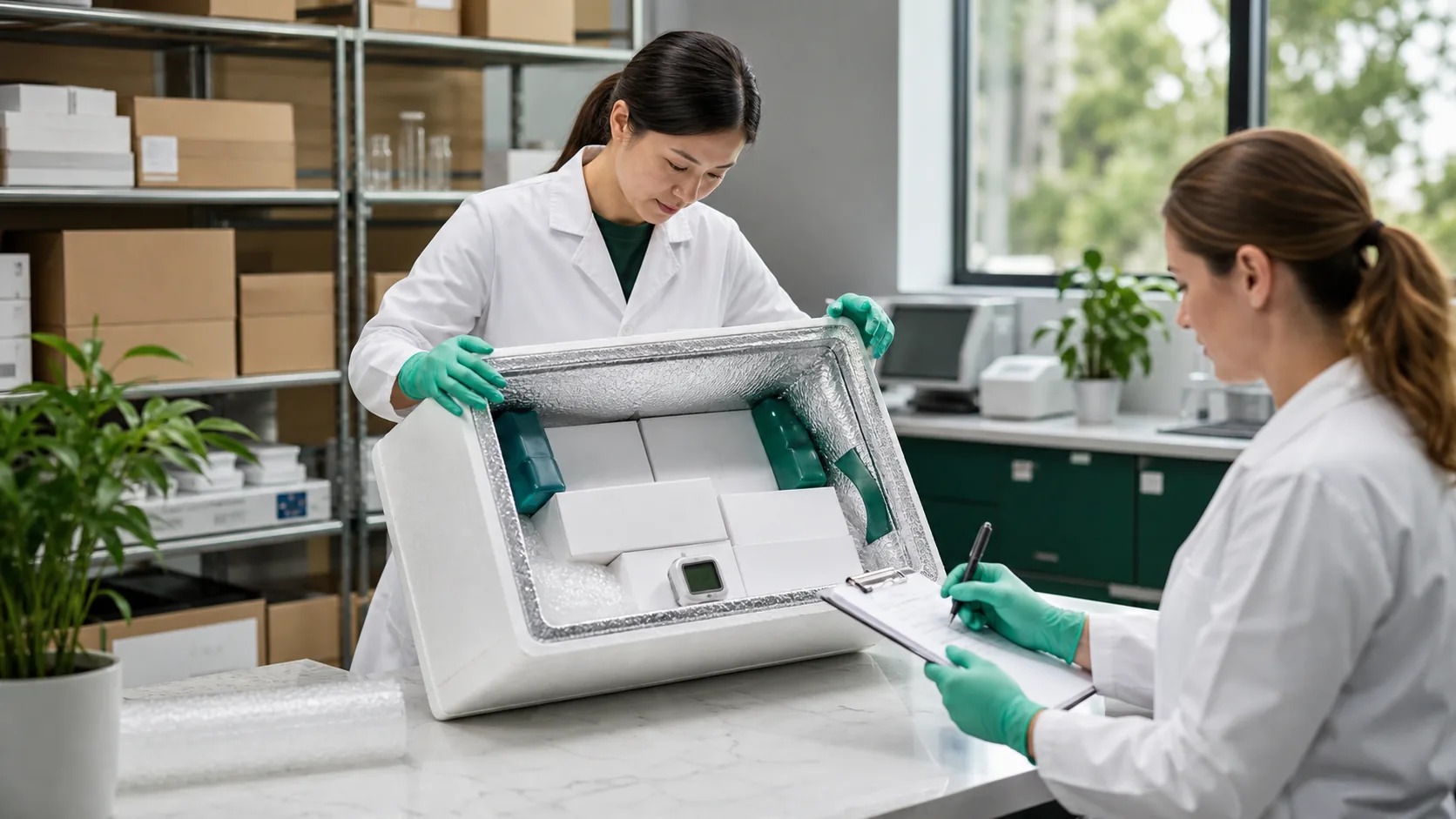
The shipping and handling phase is a critical vulnerability in the research peptide supply chain. A peptide manufactured to 99% purity is worthless if it arrives degraded from improper shipping conditions. This guide covers the science of peptide stability during transit and the practical measures that protect product integrity from manufacturer to laboratory.
Shipping Temperature Requirements
| Peptide Form | Acceptable Range | Recommended Shipping | Risk Level |
|---|---|---|---|
| Lyophilized (stable peptides) | Below 25°C | Cold packs + insulated box | Low-moderate |
| Lyophilized (sensitive peptides) | Below 10°C | Cold packs or dry ice | Moderate |
| Reconstituted solutions | 2-8°C | Cold packs + validated packaging | High |
| Proteins (Follistatin, etc.) | Below -20°C | Dry ice required | Very high |
Cold Chain Components
| Component | Function | Duration |
|---|---|---|
| Gel ice packs | Maintain 2-8°C environment | 24-48 hours in insulated box |
| Dry ice (CO2) | Maintain -78°C environment | 24-72 hours depending on quantity |
| Insulated foam liner | Thermal barrier | Extends cold pack effective time 2-3x |
| Temperature indicator | Monitors excursion events | Documents if temperature exceeded threshold |
| Outer corrugated box | Physical protection | Prevents crush damage |
Seasonal Considerations
Shipping conditions vary dramatically by season:
- Summer (June-September): Package temperatures can exceed 50°C in delivery vehicles. Expedited shipping with extra cold packs is essential. Consider Monday-Wednesday shipping to avoid weekend warehouse storage
- Winter (December-February): Freezing is rarely a concern for lyophilized peptides but can cause vial breakage if reconstituted solutions freeze and expand. Insulation protects against both heat and cold
- Optimal shipping: Spring and fall months provide the most moderate transit temperatures
Receiving Protocol
- Step 1: Inspect outer packaging for damage upon delivery
- Step 2: Open immediately; do not leave in mailroom or loading dock
- Step 3: Check cold pack status (should still be cold/partially frozen)
- Step 4: Inspect vials for cracks, broken seals, or discoloration
- Step 5: Verify contents against order (correct peptides, quantities)
- Step 6: Store at appropriate temperature immediately (-20°C for lyophilized)
- Step 7: File Certificate of Analysis with batch records
Supplier Shipping Standards
When evaluating a peptide supplier, assess their shipping practices:
| Standard | Premium Supplier | Budget Supplier |
|---|---|---|
| Cold packs | Included (standard) | Extra charge or none |
| Insulation | Foam liner or thermal box | Bubble wrap only |
| Transit time | 2-3 day express options | Ground only (5-7 days) |
| Temperature monitoring | Indicator included or available | Not available |
| Replacement policy | Replace if compromised | No guarantee |
Key Research Context
Understanding the research context for Peptide Shipping & Handling Best Practices requires consideration of multiple factors including compound purity, experimental design, appropriate controls, and reproducibility standards. The scientific literature provides a foundation for evaluating the biological activity and potential applications of this compound category.
Research-grade compounds require rigorous quality verification before use in any experimental protocol. This includes confirming identity via mass spectrometry, verifying purity via HPLC chromatography (targeting ≥98% for definitive studies), and ensuring proper storage conditions have been maintained throughout the supply chain. A validated Certificate of Analysis from the supplier, ideally with third-party verification, is the minimum standard for quality assurance.
Experimental Design Considerations
Researchers should consider several practical factors when designing experiments with this compound. Dose-response curves should be established using at least three concentration points spanning the expected effective range. Vehicle controls must match the reconstitution buffer exactly. Time-course experiments help determine optimal treatment duration and peak effect windows. For in vivo studies, route of administration significantly affects bioavailability and tissue distribution patterns.
Proper reconstitution technique is essential for accurate dosing. Always inject diluent slowly along the vial wall rather than directly onto the lyophilized cake. Gentle swirling (never vortexing or shaking) prevents aggregation and denaturation. Use bacteriostatic water for multi-dose vials and sterile water for single-use preparations. Record the reconstitution date, concentration, and storage conditions for each vial.
Literature and Evidence Standards
When evaluating the research evidence for any peptide compound, consider the hierarchy of evidence: randomized controlled clinical trials provide the strongest evidence, followed by controlled preclinical studies in validated animal models, then in vitro cell culture studies, and finally computational or theoretical analyses. The number of independent research groups replicating findings, publication in peer-reviewed journals, and consistency of results across different experimental systems all contribute to the overall evidence quality assessment.
Researchers should also be aware of publication bias (positive results are more likely to be published than negative results) and the importance of proper statistical analysis in interpreting study outcomes. Effect sizes, confidence intervals, and appropriate statistical tests are as important as p-values in evaluating research significance. For a comprehensive understanding of peptide quality metrics, review our guide on what 98% purity means and how to interpret analytical data from qualified suppliers.
Methodological Framework
Rigorous research methodology is essential for generating reliable data with any research compound. The following framework outlines best practices for experimental design, quality control, and data interpretation that apply to studies involving this compound category.
Quality Control Protocol
Before initiating any experimental protocol, verify the compound identity and purity through independent analytical testing. The minimum verification standard includes reversed-phase HPLC analysis confirming ≥98% purity and mass spectrometry confirming the correct molecular weight within ±1 Da of the theoretical value. For compounds with disulfide bonds or metal coordination (such as copper peptides), additional analytical methods may be required to confirm proper folding or complexation. Document the lot number, vendor, CoA reference, and storage conditions for every compound used in research.
Dose-Response Characterization
Establishing a complete dose-response curve is fundamental to characterizing any bioactive compound. Use a minimum of five concentration points spanning at least two logarithmic orders of magnitude. Include both sub-threshold and supra-maximal concentrations to define the full response range. Calculate EC50 (half-maximal effective concentration) values using nonlinear regression with appropriate curve-fitting models. For in vivo studies, allometric scaling from published animal data provides initial dose estimates, but species-specific pharmacokinetic differences necessitate empirical dose optimization.
Controls and Replication
Every experiment requires appropriate controls: vehicle controls (matching the reconstitution buffer composition exactly), positive controls (a compound with known activity in the assay system), and negative controls (untreated or inactive analog). Biological replicates (independent experiments on different days with different cell passages or animal cohorts) are more informative than technical replicates (repeated measurements of the same sample). A minimum of three biological replicates is standard for publication-quality data. Statistical analysis should include measures of central tendency, variability (standard deviation or standard error), and appropriate hypothesis testing with correction for multiple comparisons where applicable.
Safety and Handling
All research compounds should be handled according to standard laboratory safety protocols. Wear appropriate personal protective equipment (gloves, lab coat, eye protection) when handling lyophilized powders and reconstituted solutions. Avoid inhalation of lyophilized powder during reconstitution. Dispose of unused compound and contaminated materials according to institutional biosafety and chemical waste guidelines. Research peptides are intended for laboratory research use only and are not approved for human therapeutic use unless specifically noted (such as FDA-approved compounds like Tesamorelin).
Proper storage extends compound viability and ensures consistent experimental results. Lyophilized compounds should be stored at -20°C with desiccant in sealed containers. After reconstitution with bacteriostatic water, store at 2-8°C and use within the validated stability window (typically 3-4 weeks). For long-term storage of reconstituted solutions, prepare single-use aliquots and freeze at -20°C to avoid repeated freeze-thaw cycles that accelerate degradation.
Current Research Landscape
The research landscape for this compound category continues to evolve as new preclinical and clinical data emerge. Academic institutions, pharmaceutical companies, and independent research laboratories worldwide contribute to the growing body of knowledge through peer-reviewed publications, conference presentations, and registered clinical trials. Understanding the current state of evidence helps researchers identify knowledge gaps, design informative experiments, and place their findings in appropriate scientific context.
Several factors are driving increased research interest in peptide-based compounds. First, advances in solid-phase peptide synthesis have dramatically reduced manufacturing costs and improved batch-to-batch consistency, making high-purity research compounds more accessible. Second, improved analytical technologies (high-resolution mass spectrometry, advanced HPLC methods, and circular dichroism spectroscopy) enable more precise characterization of peptide structure and purity. Third, the growing understanding of endogenous peptide signaling systems has revealed new therapeutic targets and research opportunities.
Researchers entering this field should familiarize themselves with the foundational literature, establish validated experimental protocols with appropriate controls, and ensure all compounds meet rigorous quality standards before use. The Peptera Research library provides comprehensive guides covering reconstitution, storage, analytical verification, and supplier evaluation to support reproducible, high-quality research outcomes.
Frequently Asked Questions
How should research peptides be shipped?
In insulated packaging with cold packs, using expedited shipping (2-3 day). Lyophilized peptides are more resilient than reconstituted solutions, but cold-chain shipping is always best practice.
What do I do if cold packs arrive thawed?
For lyophilized peptides, brief room-temperature exposure (1-2 days) typically causes minimal degradation. Store immediately at -20°C. Document the condition and contact the supplier. If you suspect degradation, re-analyze by HPLC or request replacement.
The Bottom Line
This compound represents an active area of peptide research with significant preclinical data supporting further investigation. All research applications require proper analytical verification and adherence to established protocols.
Explore the Research Catalog
All Peptera Research compounds ship with third-party verified Certificates of Analysis.
View CatalogFOR RESEARCH USE ONLY. NOT FOR HUMAN CONSUMPTION. This article is intended for educational and informational purposes only. It does not constitute medical advice. Last updated: April 20, 2026.